|
Pumps/Taps/Pillars/Standpipes/Hydrants/Fountains/Wells/Bores... | |
|
Let's get some definitions out of the way, because there's a degree of confusion between all of these, not helped by multiple entries in dictionaries - which only add to the confusion - or by manufacturers who in the past have gone for over-the-top descriptions of their products. So, in the context of this website and the old pumps featured in it, here are the definitions I've adopted:
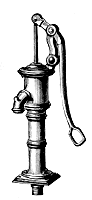
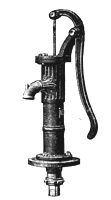
| A pump is a device using mechanical effort to transfer water through a pipe or spout from its source to another location or container. | If the device supplying water is connected to the pressurised water mains it is therefore not a pump, as it requires no mechanical effort to lift the water. Some very solid-looking cast iron devices which appeared in our streets when mains water was introduced were often termed water pillars. If you're still with me, and not gone off into a total stupor, many old pumps, especially ornate and grand municipal ones, were also converted to work off the water mains - and therefore can no longer be called pumps. | A tap is essentially an open-ended valve which can be opened/closed in order to allow water to flow out. It is most usually seen connected to a mains water supply but can also be fitted to the spout or delivery pipe of a pump. At one time the term "cock" was used to describe a tap, but this usage now only remains in the term stopcock, it being a valve located within a pipe to isolate the supply of water. |
| A standpipe is a large vertical pipe through which water is delivered under pressure. | 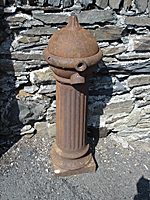 THIS IS NOT A PUMP: IT'S A WATER PILLAR. |
A hydrant is a discharge pipe with a valve and spout at which water may be drawn under pressure from the water mains, typically for the purpose of extinguishing fires, washing down streets, or flushing out the water main. (Modern hydrants can also be tucked away below road level, of course, under cast iron covers.) |
| A well is simply a deep hole or shaft dug to obtain water, whereas a bore is by definition far narrower, and is typically drilled. | A fountain is a device that produces and contains an artificially created stream of water, under pressure. The term pillar fountain, used rather too broadly by some manufacturers in their catalogues, can reasonably be used if the jet of water is directed vertically upwards, under pressure. |
| And while we're at it, let's take a quick look at devices that have fooled many of us in the past - fake/replica pumps and other assorted street objects. |
|Home|